Health Articles
Knowledge
“PCNL” A New Method for Treating Kidney Stones Using Percutaneous Endoscopy
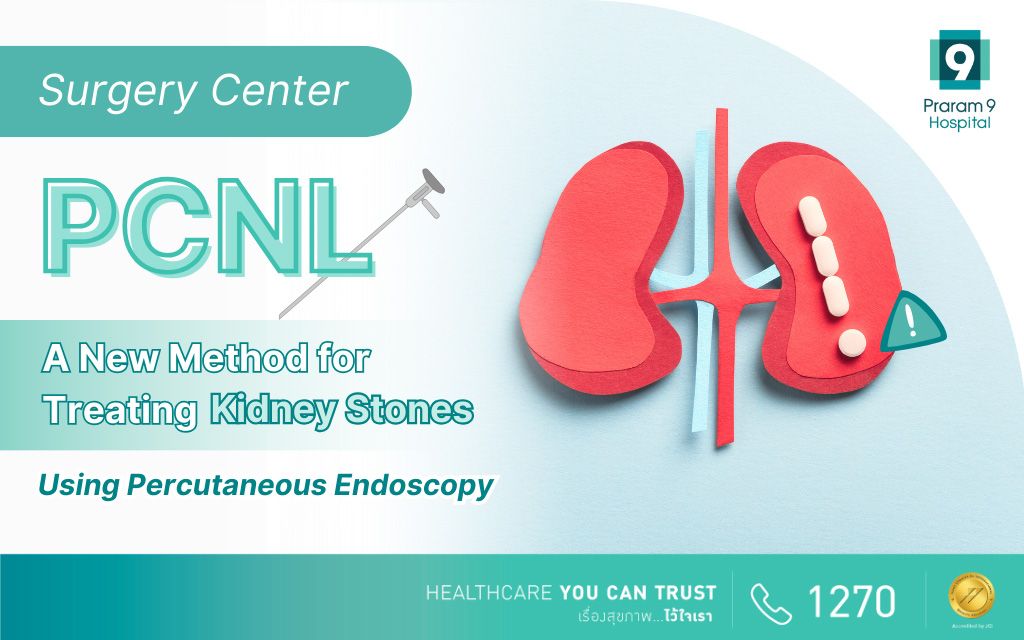
When discussing stones in the human body, the most commonly mentioned are gallstones and urinary stones. Although both are types of stones, their formation mechanisms differ, requiring treatment by specialists in different medical fields. This article explores a new and improved method for treating kidney stones, known as PCNL (Percutaneous Nephrolithotomy), or kidney stone surgery using percutaneous endoscopy.
Urinary tract stones are a common condition, with kidney stones being the most frequently found, followed by ureteral stones, bladder stones, and urethral stones, respectively. In Thailand, the incidence of stone disease is higher in the northern and northeastern regions. It is observed that the occurrence of stones is 2-3 times more common in men than in women.
Table of contents
- Kidney Stones
- Symptoms of Kidney Stones
- Treatment of Kidney Stones
- What is Percutaneous Nephrolithotomy (PCNL)?
- Advantages of Treating Kidney Stones with Percutaneous Nephrolithotomy
- Complications of Treating Kidney Stones with Percutaneous Nephrolithotomy
- Prevention of Recurring Kidney Stones
- Conclusion
Kidney Stones
Urinary tract stones are hard masses formed from the crystallization or precipitation of substances in urine. Kidney stones are specifically those that form within the kidneys. These stones can obstruct the flow of urine and promote further precipitation. If left untreated, kidney stones can grow larger, potentially blocking urine flow and leading to kidney failure. Additionally, these stones can serve as a breeding ground for bacteria, increasing the risk of kidney infections and subsequent bloodstream infections.
Generally, kidney stones are classified into two main groups:
- Radiopaque Stones: These are more common type and often contain calcium, making them visible on X-rays.
- Non-Radiopaque Stones: These are less common and usually consist of uric acid, making them invisible on X-rays. Diagnosing these stones can be more challenging and may require additional tests such as ultrasound, contrast X-ray, or computed tomography (CT) scans.
Symptoms of Kidney Stones
The symptoms of kidney stones can vary depending on the size of the stone, its location, and the degree of obstruction in the urinary tract. Here are some common symptoms:
- Small Stones: Often, small stones can pass through the urinary tract without causing noticeable symptoms.
- Large Stones: Larger stones can block the urinary tract, leading to symptoms such as:
- Severe pain in the lower back or flank, below the ribs.
- Pain in the lower abdomen and may radiate to the groin if the stone obstructs the ureter.
- Sudden, sharp pain that may come and go if the stone moves or obstructs different areas.
- Bleeding: In severe cases, urine may be tinged with blood or appear reddish, similar to “meat wash.”
- Infection: If a stone causes an infection, symptoms may include:
- Painful or burning urination.
- Cloudy or foul-smelling urine.
- Persistent urge to urinate.
- Severe cases may result in fever and chills.
- Kidney Failure: If stones obstruct both kidneys, it can lead to reduced kidney function and chronic kidney failure. Symptoms include:
- Decreased urine output.
- Swelling due to fluid retention.
- Anemia.
- Asymptomatic: In some cases, individuals may not experience any symptoms, and stones may be discovered incidentally during routine health check-ups or kidney screenings.
Treatment of Kidney Stones
Historically, kidney stones in the urinary tract were treated with open surgery. However, there are now more options available, including improved techniques that reduce recovery time and offer better outcomes.
Medication
Dissolving Stones: Medications can dissolve uric acid stones by making the urine more alkaline. However, there are no medications available for dissolving calcium-based stones. For stones smaller than 0.5 cm, increasing water intake or using diuretics might help them pass naturally.
Extracorporeal Shock Wave Lithotripsy (ESWL)
This method uses external shock waves to break the stones into smaller pieces, which can then be passed out of the body. ESWL is suitable for stones smaller than 2 cm and when the affected kidney is functioning well enough to expel the fragmented stones. However, some very hard stones may not be broken down effectively by ESWL.
Endoscopic Ureteroscopy
This technique involves inserting a scope through the urethra to locate and remove stones in the bladder or ureter. The procedure allows the physician to grasp or fragment the stones directly.
Percutaneous Nephrolithotomy (PCNL)
PCNL is a method used for treating large kidney stones, especially those with complex shapes like stag-horn calculi. It involves making a small incision in the skin and using a scope to access and remove the stones directly from the kidney. This technique is particularly suitable for large stones that are too big to be managed with other methods.
Percutaneous Nephrolithotomy (PCNL)
PCNL is a minimally invasive method for treating kidney stones that avoids traditional open surgery. In this procedure:
- Small Incision: A small incision, about the size of a fingertip, is made in the back at a position corresponding to the kidney.
- Access to the Kidney: The incision provides access to the kidney through the renal pelvis by creating a direct pathway from the skin.
- Endoscope and Tools: A scope is inserted to visualize the stone, and specialized instruments are used to break the stone into smaller pieces.
- Stone Removal: The fragmented stones are either suctioned out or removed with forceps.
- Post-Procedure: A drainage tube is placed to reduce kidney swelling, and a urinary catheter may be inserted. Most patients have these removed within 1-2 days.
PCNL is particularly effective for large or complex kidney stones and offers a quicker recovery compared to traditional surgery.
Advantages of Treating Kidney Stones with Percutaneous Nephrolithotomy (PCNL)
- Minimally Invasive: PCNL is a non-open surgical method, avoiding traditional large incisions.
- Small Incision: The incision is only about 1-2 cm in size, much smaller compared to open surgery, which typically involves a 15-20 cm incision.
- Minimal Scarring: Due to the small incision, there is less risk of significant scarring or adhesion formation.
- Less Pain: The procedure generally results in less pain compared to open surgery.
- Shorter Recovery Time: Patients usually recover quickly and can discharge from hospital within 3-5 days after the procedure.
- Quick Recovery: The overall recovery period is shorter, with most patients experiencing a faster return to normal activities.
- Complete Stone Removal: The procedure often allows for the removal of all kidney stones.
- Effective Treatment: PCNL provides good results with less kidney tissue loss compared to traditional methods.
- Re-treatment Possibility: If new stones develop, they can often be treated with PCNL again.
However, the suitability of PCNL for each patient will be determined by the physician, taking into account the best possible outcomes, safety, and minimal side effects.
Complications of Treating Kidney Stones with Percutaneous Nephrolithotomy (PCNL)
Although PCNL is generally a safe procedure, there are potential complications that may arise:
- Minor Bleeding: Slight bleeding in the urine is common but usually resolves on its own within a short period.
- Low-Grade Fever: Some patients may experience a mild fever following the procedure.
- Infection: There is a risk of infection, which may require additional treatment.
- Conversion to Open Surgery: In rare cases, complications may necessitate a conversion to open surgery, although this is uncommon.
To minimize the risk of severe complications, PCNL should be performed by a skilled specialist with expertise in this procedure.
Prevention of Recurring Kidney Stones
Kidney stones can recur after treatment, with recurrence rates as high as 35-50% within 5-10 years if preventive measures are not taken. Therefore, it’s crucial to follow strategies to prevent recurrence. If any factors promoting stone formation are identified, consult a physician for appropriate treatment. Additionally, adopting the following lifestyle changes can help reduce the risk of recurrence:
- Stay Hydrated: Drink at least 2-3 liters of water daily to keep urine diluted and prevent it from becoming concentrated, which can lead to stone formation.
- Reduce Salt Intake: High salt consumption increases calcium excretion in the urine, which can promote stone formation. Reducing salt intake helps lower calcium levels in urine.
- Manage Uric Acid Levels: Control high uric acid levels through diet and, if necessary, medication. Limit foods high in uric acid to help prevent stone formation.
- Regular Exercise: Engage in regular physical activity to help move stones and promote their passage. Exercise also helps prevent small stones from growing larger. Ensure adequate hydration, especially if you sweat a lot during exercise.
- Regular Medical Check-Ups: Follow up with your physician regularly, even after successful treatment of kidney stones, to monitor for potential recurrence and address any new issues.
Implementing these preventive measures can significantly reduce the likelihood of kidney stones recurring and contribute to overall kidney health.
Conclusion
PCNL (Percutaneous Nephrolithotomy) is a modern surgical technique for removing large kidney stones with results comparable to open surgery. It features smaller incisions, less pain, faster recovery, and minimal kidney tissue loss. These advantages make PCNL an excellent choice for treating large kidney stones, offering significant advantages over traditional open surgery.